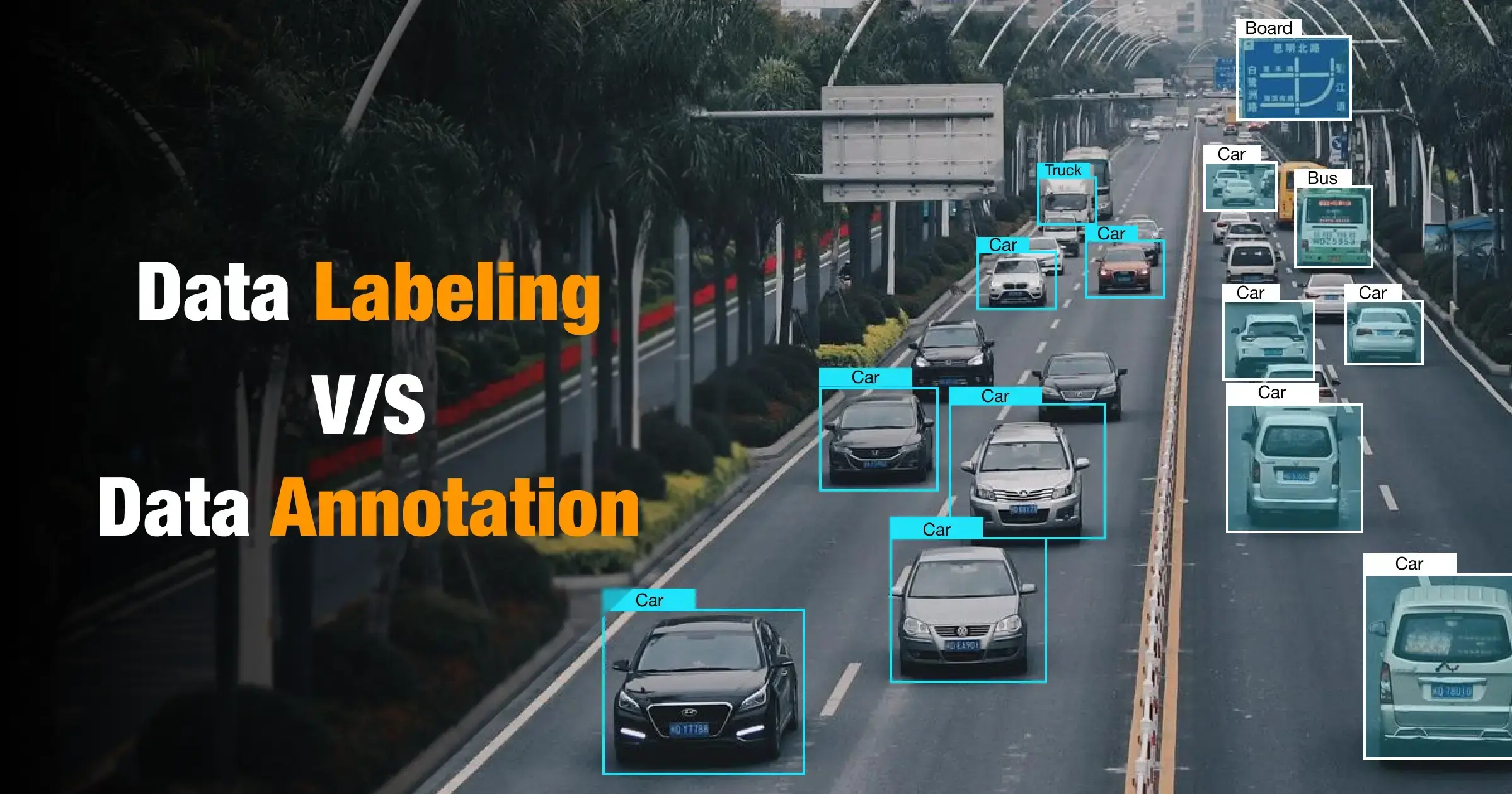
Many people apply to AI training platforms without fully understanding the type of work involved.
In job listings, the terms “data annotation” and “data labeling” often appear interchangeable. In reality, they represent two very different categories of work, requiring different levels of expertise and offering different compensation. One focuses on helping AI systems reason about complex information, while the other mainly involves classifying or tagging data.
The difference is not just terminology. It determines whether a platform contributes meaningfully to AI development or simply processes large volumes of simple tasks.
Understanding this distinction is important, especially if you want to pursue higher-value work in AI training.
Data annotation vs. data labeling at a glance
In general, data annotation requires deeper expertise and contextual understanding, while data labeling relies primarily on careful attention to detail and consistent rule-following.
For example, a researcher with a PhD in chemistry reviewing molecular structures for an AI model operates at a completely different level than someone categorizing thousands of product images. The difference in expertise naturally leads to differences in compensation and project scope.
Below are several key areas where annotation and labeling differ, and why those differences matter when choosing the kind of work you pursue.
Scope and definition
Data labeling focuses on assigning a single category or value to each piece of data. A typical example would be labeling product images as “shoes,” “clothing,” or “accessories” for an e-commerce system. These tasks help AI models recognize basic patterns such as identifying objects or classifying simple sentiment.
Data annotation goes further by adding context and structure within each data point. Instead of simply labeling an image as “shoe,” annotation might involve drawing bounding boxes around the shoe, marking specific features like laces or soles, and adding attributes such as “running shoe” or “formal shoe.”
In text data, annotation might involve identifying named entities (such as distinguishing “Apple Inc.” from the fruit “apple”), tagging sentiment, or mapping relationships between different entities within a sentence.
This distinction directly affects earning potential. Labeling requires accuracy and consistency but usually doesn’t demand specialized expertise. Annotation, on the other hand, often requires domain knowledge developed through years of study or professional experience.
Workflow complexity
Data labeling workflows tend to be straightforward. Workers receive guidelines, apply labels according to those instructions, and the results are occasionally checked through sampling or spot-checks. Once the pattern is understood, productivity can remain relatively high, with workers processing many items per hour.
Data annotation typically involves multiple stages and quality checkpoints. Workers may need to refine AI-generated pre-labels, correct algorithmic mistakes, and flag ambiguous cases for further review.
After submission, annotated data may pass through several additional layers of quality control, including automated validation systems, peer reviews, and expert verification. Because annotation work influences how models learn complex behaviors, errors can have larger downstream consequences.
Skill and tool requirements
Most data labeling projects are designed to be accessible to workers with strong attention to detail and the ability to consistently follow instructions.
The tools used for labeling are usually simple and optimized for speed, often consisting of web-based interfaces where users select categories or tags from predefined lists.
Data annotation often requires deeper technical or professional expertise. On platforms connected to Coral Mountain, projects are typically aligned with the annotator’s background and domain knowledge.
Compensation levels usually reflect the complexity of the work:
- STEM-related projects may pay $40+ per hour, requiring expertise in subjects such as mathematics, physics, biology, or chemistry to evaluate scientific reasoning.
- Coding projects can pay $40+ per hour for developers capable of analyzing AI-generated code in languages like Python, JavaScript, C++, or SQL.
- Professional domains such as law, finance, or medicine may reach $50+ per hour, where specialized judgment is required.
The tools used for annotation also reflect this complexity. Advanced platforms support features like bounding boxes, polygon segmentation, timeline-based video annotation, and entity-relationship mapping for text data. Learning these tools takes time, but the higher skill requirement often translates into higher pay.
Cost, scale and quality assurance
Because labeling tasks are simple, they can be performed at large scale with relatively low cost. Quality assurance usually involves random sampling of completed work to ensure consistency.
Companies can quickly expand labeling operations by adding more workers, which means onboarding is generally faster and projects are easier to scale. However, this also means competition among workers can be higher.
Annotation projects are different. Since annotated data often trains more sophisticated models, mistakes can propagate and degrade model performance. As a result, annotation workflows usually include stricter quality control.
Work may pass through automated validation checks, peer review, and expert verification before being accepted. This layered review process helps maintain accuracy and reliability for high-value AI training datasets.
Data annotation vs. data labeling: How AI training works at the frontier scale
Modern frontier AI systems operate under very different constraints than traditional machine learning systems.
Early machine learning models primarily focused on pattern recognition, such as classifying images or detecting sentiment in text. In those cases, large quantities of labeled data were sufficient.
Today’s frontier models—such as systems capable of writing code, solving complex reasoning problems, or interpreting nuanced language—require something different.
They require high-quality annotated data created by experts.
Labeling helps models learn patterns.
Annotation helps models develop judgment and reasoning.
When earlier models like GPT-3 were trained, companies could scale progress by increasing the amount of labeled data. But newer models require carefully annotated examples demonstrating reasoning steps, edge-case handling, and expert decision-making.
This shift is why annotation work is becoming more specialized and better compensated. The real bottleneck in advanced AI development is no longer data volume — it is data quality.
At Coral Mountain, AI trainers work on tasks that help refine frontier AI systems. Their evaluations help models better understand complex language, improve code generation, and reason about scientific or technical problems.
How to get an AI training job?
Platforms associated with Coral Mountain typically use a tiered qualification system designed to evaluate real capabilities rather than just credentials.
For coding-related projects, which may start around $40 per hour, applicants often evaluate AI-generated code across languages such as Python, JavaScript, HTML, C++, C#, or SQL.
The entry process generally begins with a Starter Assessment, which takes about 1–2 hours to complete. This assessment focuses on demonstrating your ability to perform the work rather than simply verifying your résumé.
After qualifying, workers can access a dashboard displaying available projects that match their skill level. Each project description outlines requirements, expected workload, and deliverables.
One advantage of this structure is flexibility. Workers typically choose their own schedule. They may work daily, occasionally, or whenever projects fit their availability. There are no strict hourly commitments or penalties for taking breaks when needed.
The work adapts to your schedule rather than the other way around.
At the same time, the tasks are intellectually demanding. They often require careful reasoning, attention to nuance, and the ability to evaluate complex outputs from AI systems.
Explore AI training work at Coral Mountain today
The difference between AI systems that perform well in real-world applications and those that only succeed in benchmarks often comes down to the quality of their training data.
If you have strong technical skills, domain expertise, or the ability to evaluate complex reasoning, AI training work connected with Coral Mountain places you close to the frontier of modern AI development.
Rather than simple gig work, these projects contribute to the infrastructure used to train next-generation AI systems.
Getting started typically involves five steps:
- Visit the Coral Mountain application page and select “Apply.”
- Fill out a short form describing your background and availability.
- Complete the Starter Assessment.
- Check your email for the approval decision within a few days.
- Log into your dashboard, select a project, and begin working. n
There are no signup fees, and participation is selective to maintain quality standards. Because the Starter Assessment is usually limited to a single attempt, it’s best to prepare carefully before beginning.
If you believe that quality matters more than volume in building advanced AI systems, and you have the expertise to contribute, opportunities through Coral Mountain may be worth exploring.
Coral Mountain Data is a data annotation and data collection company that provides high-quality data annotation services for Artificial Intelligence (AI) and Machine Learning (ML) models, ensuring reliable input datasets. Our annotation solutions include LiDAR point cloud data, enhancing the performance of AI and ML models. Coral Mountain Data provide high-quality data about coral reefs including sounds of coral reefs, marine life, waves, Vietnamese data…