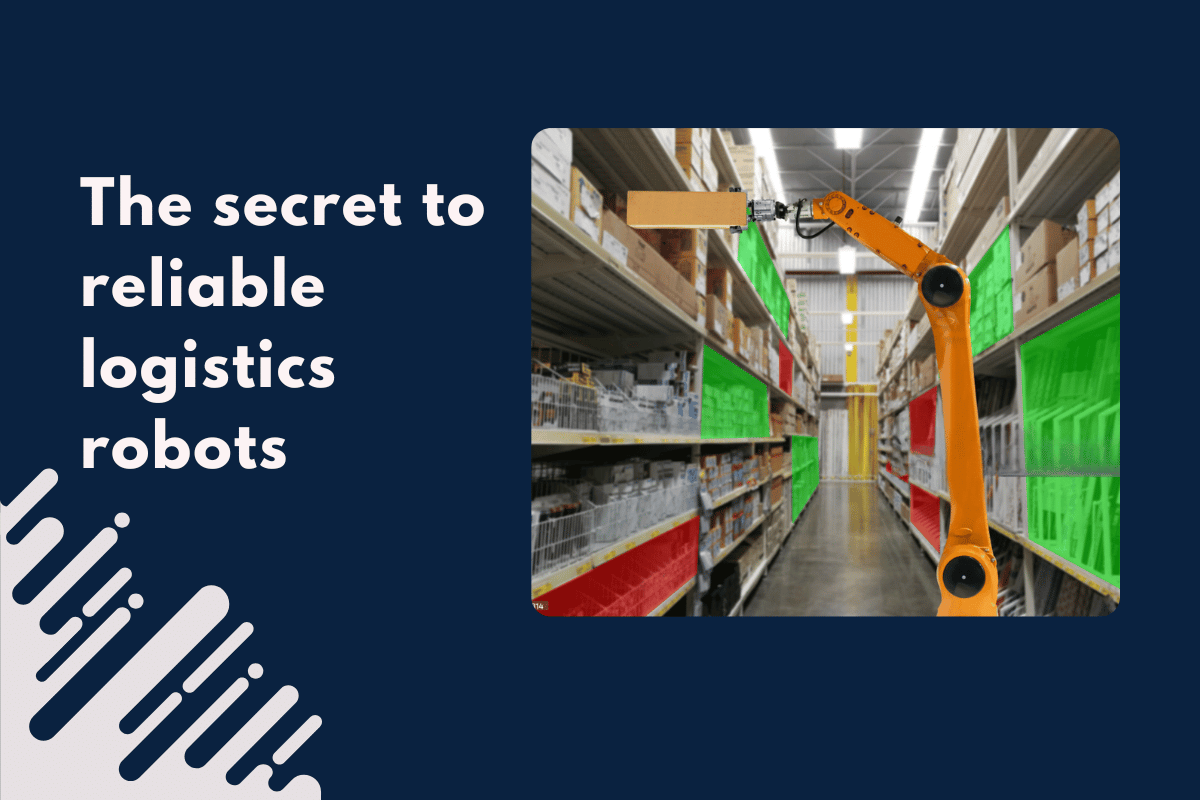
Explore how high-quality data labeling drives perception, navigation, and automation in logistics robotics
In today’s fast-moving logistics landscape, robotics has transformed how warehouses operate-from inventory handling and order fulfillment to last-mile delivery. As global supply chains push for greater efficiency, lower costs, and higher accuracy, robotics has become a key enabler.
At the core of every capable logistics robot, however, is something less visible but equally critical: high-quality data labeling.
Data labeling-the process of annotating datasets for machine learning (ML)-is what allows robots to perceive, interpret, and interact with their environment. In logistics, that could mean recognizing a parcel, navigating around a forklift, or building a real-time map of a warehouse.
Modern robots are no longer limited to repetitive, structured tasks. They operate in semi-structured or dynamic environments, adapt to changes, and make autonomous decisions. All of this depends on ML systems trained on large volumes of accurately labeled data-the foundation of perception-driven robotic intelligence.
The role of data labeling in robotics
Robotic perception refers to a machine’s ability to sense and understand its surroundings well enough to act. This capability relies on ML models trained with context-rich labeled data that reflects real-world operating conditions.
Key roles of data labeling in robotics:
- Perception: Enables robots to detect objects, interpret spatial relationships, and identify navigable paths
- Context awareness: Helps distinguish between moving and static elements (e.g., humans vs. shelving units)
- Action planning: Supports decisions such as picking, sorting, placing, or navigating
- Continuous learning: Allows systems to improve over time as new labeled data is introduced
In logistics environments, these capabilities translate into fewer picking errors, faster processing, optimized routing, and safer collaboration between humans and machines.
Key data labeling techniques for logistics robots
To build reliable robotic systems, multiple annotation techniques are applied across different data types, including images, video, LiDAR point clouds, and sensor fusion outputs. Each method enables specific robotic behaviors.
Bounding box annotation
Bounding boxes are one of the most widely used annotation methods, defining objects within 2D or 3D space.
In logistics applications:
- Robots use bounding boxes to locate parcels, pallets, conveyor belts, and workers
- Robotic arms rely on them for accurate alignment during picking or sorting
- Mobile robots use them to navigate around obstacles
They are also essential for collision avoidance, shelf scanning, and positioning objects for manipulation tasks.
Semantic segmentation
Semantic segmentation assigns a category label to every pixel (or point), such as “floor,” “shelf,” “box,” or “human.”
This is especially valuable in logistics environments where:
- Robots must distinguish between accessible paths and blocked areas
- Storage zones, docks, and workstations need precise boundary detection
- Operations occur in cluttered or space-constrained environments
Compared to bounding boxes, segmentation provides finer spatial understanding, improving both navigation and manipulation.
Instance segmentation
Instance segmentation builds on semantic segmentation by distinguishing between individual objects within the same category.
- Enables robots to differentiate between multiple similar packages
- Critical for order picking tasks where selecting the correct item matters
- Improves efficiency in automated storage and retrieval systems (AS/RS)
This level of detail is essential when dealing with overlapping or densely packed items.
Sensor fusion annotation
Warehouse robots often rely on multiple sensors, including RGB cameras, LiDAR, radar, and depth sensors. Sensor fusion annotation aligns and labels data across these sources.
- Provides a comprehensive 360° view of the environment
- Supports autonomous mobile robots (AMRs) in complex layouts
- Enhances perception under challenging conditions like low light or occlusion
Accurate multi-sensor annotation improves obstacle detection, object recognition, and real-time navigation.
Trajectory and motion annotation
This technique tracks and labels movement paths of dynamic entities such as humans, forklifts, or automated guided vehicles (AGVs).
- Enables predictive path planning
- Helps robots adjust speed, stop, or reroute dynamically
- Improves safety in shared workspaces
It also provides insights into movement patterns, which can be used to optimize warehouse design and operations.
Applications of data labeling in logistics robotics
Once data is properly annotated, it powers nearly every capability within logistics robotics systems.
Enhancing computer vision
Computer vision forms the backbone of robotic perception. With well-labeled datasets:
- Robots can read barcodes, QR codes, and package identifiers
- Visual SLAM (Simultaneous Localization and Mapping) enables autonomous navigation
- Shelf recognition supports inventory monitoring and bin-picking
This leads to more accurate and context-aware decision-making across workflows.
Real-time decision-making via sensor fusion
In real-world operations, robots must respond instantly. Labeled multi-sensor data enables:
- Collision avoidance in fast-paced, human-robot environments
- Dynamic rerouting when paths are blocked or inventory shifts
- Precise execution of tasks such as retrieving items from high shelves
These capabilities are critical for warehouse automation, delivery robots, and autonomous forklifts.
Inventory management and tracking
Accurate labeling significantly improves inventory operations:
- Robots can scan shelves, count items, and verify SKUs automatically
- Misplaced or excess inventory is detected through visual inspection
- Integration with warehouse management systems (WMS) enables real-time updates
The result is improved space utilization, faster fulfillment, and reduced discrepancies.
Quality control and anomaly detection
Quality assurance is essential in logistics, particularly in e-commerce and manufacturing.
With labeled data, robots can:
- Identify damaged goods or incorrect packaging
- Perform consistent end-of-line inspections
- Detect anomalies in packaging, sealing, or arrangement
Automation in quality control reduces returns, enhances customer satisfaction, and ensures compliance with standards.
Conclusion
The logistics industry is entering a phase where autonomous robots are no longer just tools-they are integral to operational efficiency. From warehouses to last-mile delivery, these systems are reshaping how goods are handled and moved.
Behind every intelligent robotic action is a machine learning model. And behind every effective model is high-quality labeled data.
Data labeling does more than support logistics robotics-it enables it:
- Bounding boxes and segmentation provide spatial awareness
- Sensor fusion delivers environmental understanding
- Trajectory annotation enables safe interaction with dynamic elements
Organizations that invest in structured annotation workflows, quality assurance processes, and automation will be better positioned to scale robotic systems effectively.
Ultimately, the future of logistics depends not only on faster robots, but on smarter, better-informed ones-and that starts with the data they learn from.
Coral Mountain Data is a data annotation and data collection company that provides high-quality data annotation services for Artificial Intelligence (AI) and Machine Learning (ML) models, ensuring reliable input datasets. Our annotation solutions include LiDAR point cloud data, enhancing the performance of AI and ML models. Coral Mountain Data provide high-quality data about coral reefs including sounds of coral reefs, marine life, waves….